
This article is sponsored by LivePlan. We only work with sponsors we believe our readers will find genuinely useful, and all editorial opinions are our own.
Ask a generic artificial intelligence (AI) tool to write your business plan and it'll hand you one in about 90 seconds. That speed is the trap.
The plan will look polished. It'll have revenue projections, a market-size estimate, and a confident paragraph about your competitive advantage. What it won't have is a source for any of it. The first time someone who matters asks where a number came from, a plan built on guesses comes apart.
The lesson here isn't that AI has no place in planning. Used well, AI is one of the best things to happen to founders who aren't financial experts. The real question is: “Which AI tool should you use — and can you trust what it hands you?” Building a plan you can actually stand behind takes a different approach.
Skip Ahead To:
- Why a Business Plan Still Matters
- Why Generic AI Tools Fall Short
- What to Look for Instead
- Why an Interconnected Financial Model Matters
- Keep Your Plan Alive and Consistent
Why a Business Plan Still Matters
It's easy to think of a business plan as a document you write once to raise money, then file away. In reality, the best plans are living documents, built on your real numbers and revisited as your business grows. That difference is everything, and it starts with understanding what a plan is really meant to do.
Planning is the work of answering the hard questions about your business before the market answers them for you. Who is the customer? What will it cost to reach them? When does the math turn profitable? Writing it down forces you to think it through, and the thinking is the real value. Fundraising is one use for a good business plan, but it’s not the sole reason to have one.
Tackling these hard questions is also the part you can't hand off. When an investor asks what drives your year-two growth, you need an answer you arrived at yourself, not one a tool produced while you watched. A plan you didn't reason through yourself is one you'll struggle to stand behind, and that gap shows up fast when a lender starts asking questions.
The research backs this up. LivePlan compiled the available studies on business planning, and a few key findings stand out:
- A meta-analysis of 46 studies, covering 11,046 companies, found that planning improves performance and helps established firms even more than brand-new ones
- Writing a plan increased a new business's average annual growth by 33.4%
- Among fast-growth firms, 71% had formal written plans
- Entrepreneurs who complete a plan are 57% less likely to see their business fold
When founders seek funding, the same meta-analysis found that preparedness beats passion: the founders who can answer the hard questions with real data and understanding are the ones who get the “yes.”
So before you open any AI tool, get clear on the hard questions you need to answer. The tool is there to help you answer them, not to do it for you.
Why Generic AI Tools Fall Short
Ask a general-purpose AI tool to write a business plan and it'll produce text that reads like one. It's seen thousands of plans, so it knows the shape: the market section sounds like a market section, the financials look like financials.
The trouble is what's underneath. When a generic AI hands you a profit margin or a revenue figure, it isn't reading your books or studying your market. It's pulling from the industry averages it has seen thousands of times, so the number describes an average business, not yours. Ask where that figure came from and it usually can't tell you. It might be drawn from real data it saw in training, or it might be a plausible-sounding guess, and you have no way to know which.
That leaves you with a plan that's convincing on the surface and hollow underneath. Generic AI tools tend to give you:
- Statistics with no source to which you can point
- Projections that sound reasonable, but aren't tied to your real numbers
- Market research that reflects a generic average, not your actual industry
For a rough first draft, that might be fine. For a plan you're about to put in front of someone with money on the line, that surface polish works against you: you end up confident in numbers you can’t defend.
Imagine a founder forecasting $500,000 in first-year revenue. A generic AI tool can produce that number in seconds because it sounds plausible, but plausible isn't the same as credible. When an investor asks where those customers come from, what conversion rate was assumed, or why growth jumps in month six, the founder needs to provide fact-based answers. A projection without reasoning behind it is just a guess wearing a spreadsheet.
Here's a simple test you can run on any AI tool before you trust it: ask where a number came from. If it can't point to a source, treat it as a placeholder, not a fact. This isn't an argument against using AI to plan. It's an argument for being careful about which AI you use and how you use it.
What to Look for Instead
The fix isn't to abandon AI. Instead, use AI tools grounded in real data, and trained in actual business planning. LivePlan CEO Sabrina Parsons draws the line this way: "AI can help you write faster, but it can't manufacture credibility. The plans that hold up in investor meetings are the ones where every projection has a source and every assumption is grounded in real market data that a founder can defend."
In practice, using AI to build a business plan you can trust comes down to a simple process:
- Start with real market research and industry benchmarks —not invented figures
- Use AI tools to organize, draft, and refine your thinking — not to do the thinking for you
- Validate every key assumption and projection against a source you can name
- Stress-test your financial model with what-if scenarios before anyone else does
- Compare your plan against real results after launch, and update it as you learn what works for your business
When you're choosing a tool, start with the data behind it. A credible plan is built on verifiable industry data, with benchmarks from sources you can name and market research that reflects your actual industry. It's the difference between telling an investor "the typical margin here is 18%, and here's the source" and hoping no one asks.
This is where a purpose-built planning platform earns its place. LivePlan grounds its AI planning tool in real industry benchmarks and verified market research, for example, and then builds idea validation on genuine research rather than assumptions. The point isn't that the software thinks for you. It's that when your plan makes a claim, there's something real backing it up.
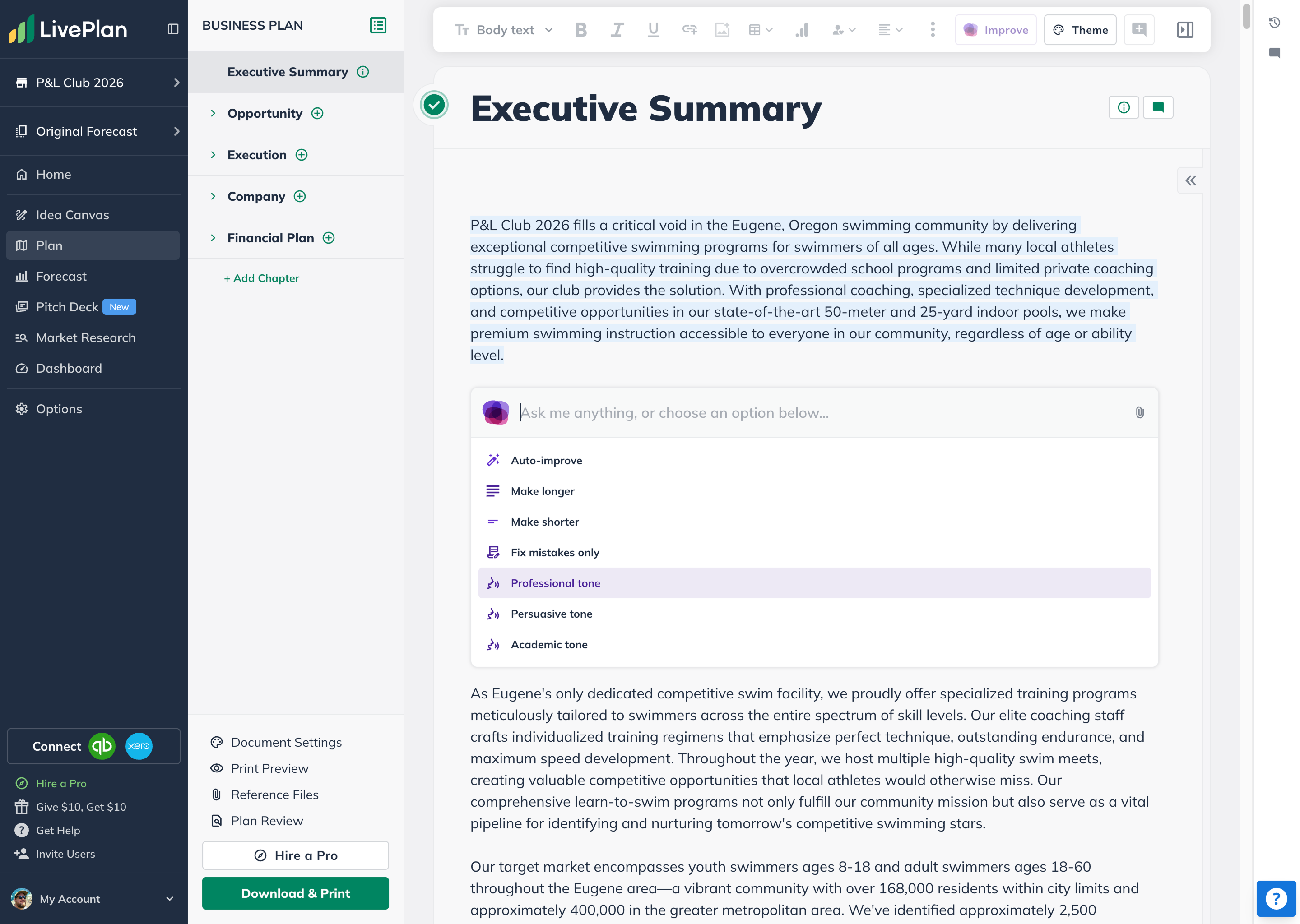
LivePlan's AI writing assistant helps founders draft and refine plan sections while keeping their work inside a structured business-planning environment.
LivePlan also has a built-in plan review that checks your plan for gaps and inconsistencies and prepares you for the questions investors tend to ask. Running this review is like a practice round before the real meeting, which is when you want to find the holes instead of while someone's staring at you across a table.
Why an Interconnected Financial Model Matters
Most founders' financial projections are disconnected guesses in a spreadsheet. Revenue lives on one tab, expenses on another, and nothing talks to each other. Change one assumption and you have to update five other cells by hand. Usually, you forget one and your plan contradicts itself.
A real financial model doesn't work that way. A true three-statement model links your income statement, balance sheet, and cash flow statement with actual accounting logic so they move together. Say you decide to hire two salespeople in month six. In a connected model, that single change flows through everything at once:
- Payroll costs rise on the income statement
- Cash drops on the cash flow statement
- The balance sheet updates to match
This matters the moment an investor starts probing. Real due diligence isn't reading your plan, it's stress-testing it. An investor will ask what happens if you grow half as fast, or if a key cost doubles. With an interconnected model you can run that scenario live and show a coherent answer. With disconnected guesses, the whole pitch wobbles.
This is where the right planning tool earns its keep. LivePlan's financial model is a true interconnected three-statement model, so testing those scenarios is fast instead of a manual rebuild every time your thinking changes.
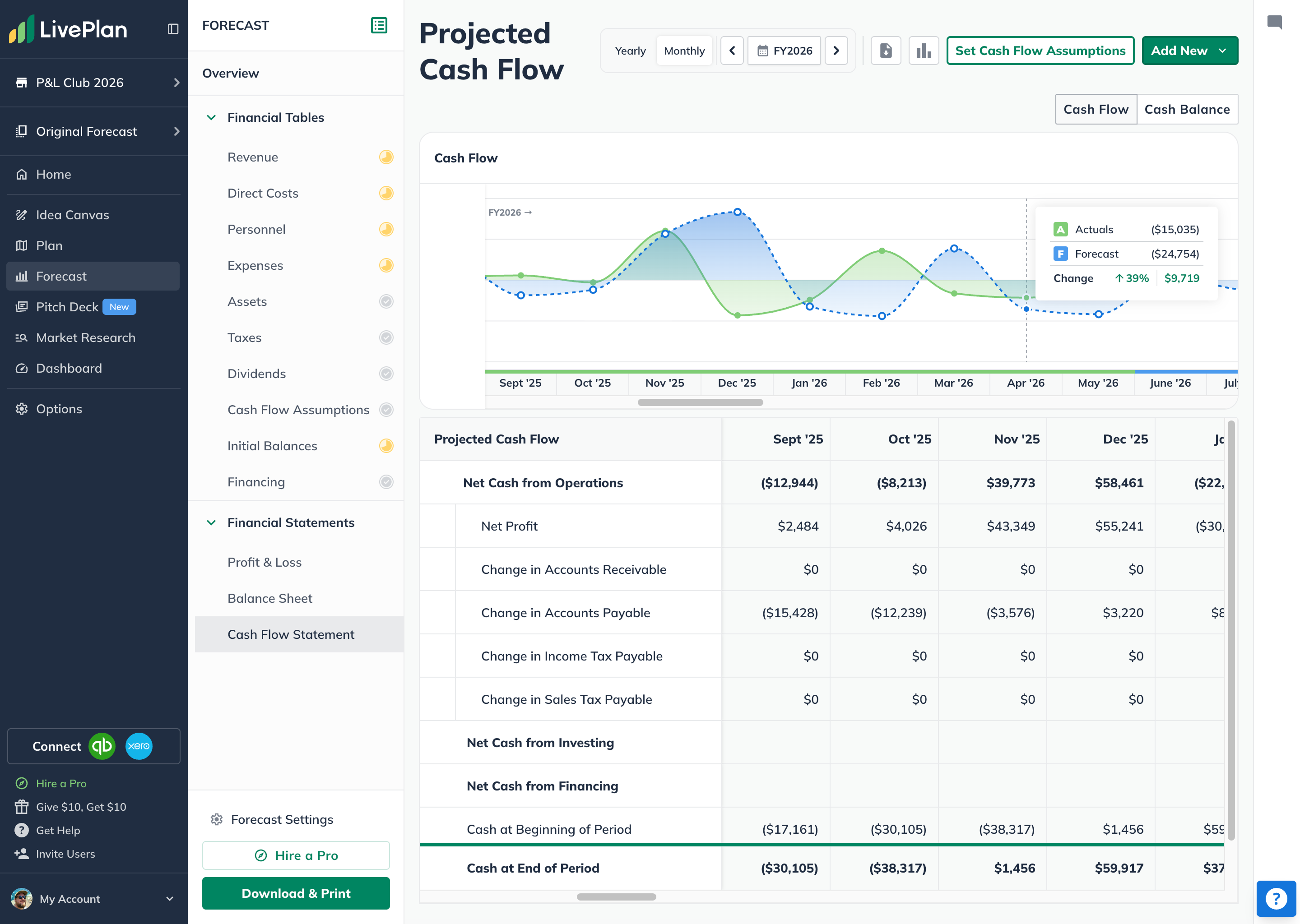
LivePlan's forecasting tools connect revenue, expenses, and cash flow, making it easier to test scenarios and understand how changes will affect the business as a whole.
Keep Your Plan Alive and Consistent
A plan is only trustworthy if it stays current — both before you launch and after.
Before launch, the risk is your documents drifting apart. Your plan, executive summary, and pitch deck all carry financial numbers. You update the plan, forget the deck, and weeks later your slide says one figure while your plan says another. An investor notices, and it makes everything else look careless. The fix is to stop keeping the numbers in separate places. An AI planning tool like LivePlan can help you keep your financials in sync between your business plan and your pitch automatically so the deck can't drift out of date.
After launch is where most founders leave value on the table. A business plan isn't finished when you open the doors; that's when it becomes useful. The plan you wrote was a set of predictions, and now you have real results to check them against. Where did reality match the plan, where did it not, and what does that tell you? That comparison is how planning becomes an ongoing decision-making tool instead of a document you filed away, and it's a big part of why the firms that keep planning outperform the ones that don't. A good plan well executed will help you make better business decisions every day.
So, put a recurring date on the calendar — monthly is a good start — to compare your forecast against what actually happened. If you use LivePlan, this AI tool integrates with QuickBooks and Xero so you can do exactly that vs. rebuilding a forecast from scratch every quarter.
The Bottom Line
AI is a genuine advantage for business planning. It speeds up the work and lowers the barrier for founders who aren't financial experts. But speed isn't the same as trust, and a plan you can’t defend fails at the worst possible moment.
The business plans that hold up share a few common traits:
- Real market research and industry benchmarks, not generic averages
- A true interconnected financial model that stays consistent under scrutiny
- A pitch and business plan that stay aligned as assumptions change
- A way to compare forecasts against actual performance after launch
A tool like LivePlan can carry the research, financial modeling, and performance tracking, so you can focus on the part that wins the room: understanding your own business well enough to defend it.
The right tools make that easier. The thinking, however, still belongs to you.