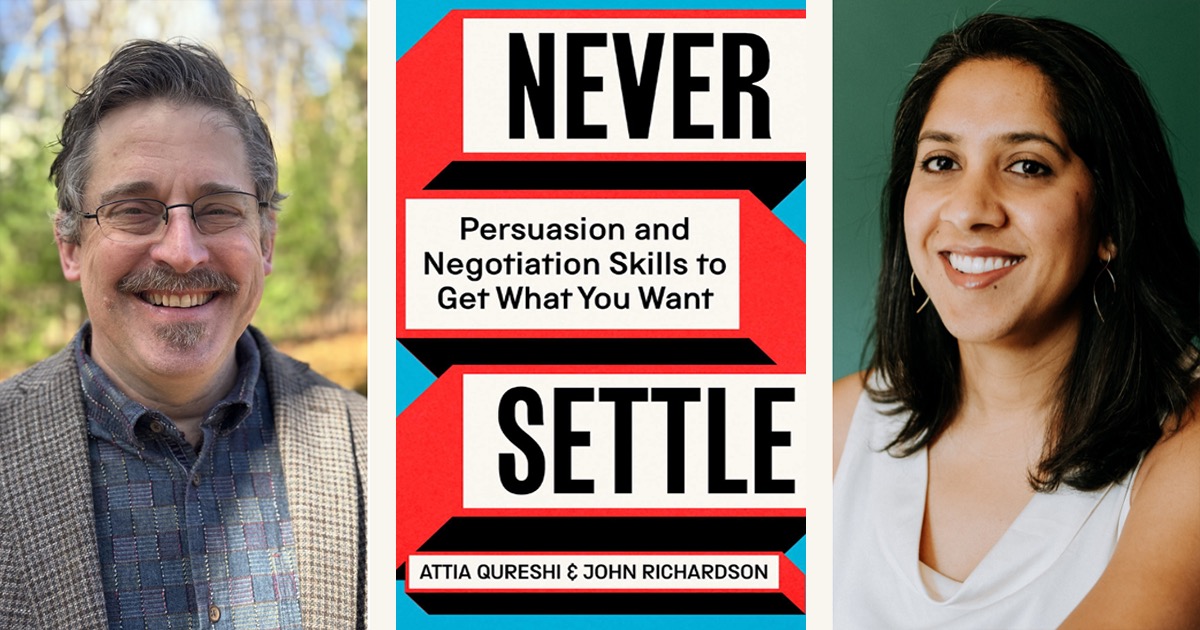
"We believe negotiation might be the most important skill you can learn," write Attia Qureshi and John Richardson in "Never Settle: Persuasion and Negotiation Skills to Get What You Want,” "but very few people, even top professionals, are very good at it."
There are many books on negotiation, but most don't close the gap between theory and successful real-world execution, the authors claim. They drill into techniques that apply not just to business but to everything from personal relationships and rowdy neighbors to achieving goals at a nonprofit or persuading others to support a political candidate.
Richardson teaches negotiation at MIT's Sloan School of Management and previously taught at Harvard Law, where his wife also taught. "Our classes were much more practice oriented than at the typical law school and the students loved our ideas and were energized by what they learned. But when they went back to their careers and daily life they gradually lost sight of what we had taught them."
It was his idea that Qureshi collaborate with him on a book to address the shortfalls in earlier writing on the subject. They had taught negotiation together at MIT for four years. Richardson had also learned from FBI agent Chris Voss how to negotiate with someone holding hostages.
Qureshi founded Attia Qureshi Consulting in 2017 to offer customized plans to rapidly growing organizations that need a culture that can adapt at every level as they evolve. She has worked with Fortune 500 companies and family businesses, and she has helped organizations resolve conflicts in the cocaine-producing regions of Colombia.
She is an adjunct at the Gerald R. Ford School of Public Policy and, in addition to teaching at MIT, served on the faculty of the Ross School of Business. She also founded a crafts producer that uses fibers from artisans around the world to create a luxury brand.
Reciprocity Is Hard-Wired, but Don't Negotiate Entirely With Logic
"One of the key ways to influence others to do what you want them to do is reciprocity, which is giving someone something they want or will appreciate," Qureshi told Startup Savant. "Neuroscience has shown that if someone is given even a small gift of any kind, there is a profound instinct to want to return the favor in some way. It's universal human behavior with a biological basis and cultural variables. In negotiation, the other party will see you as someone who is sympathetic to their feelings and even a friend."
You might bring premium coffee, chocolates, or a special sandwich to a meeting. Make a list of the people you interact with regularly and learn about their families, hobbies, music, the books they read, and their favorite TV and streaming shows. Negotiation, whether personal or professional, is much more likely to succeed if you've first built a relationship.
Building relationships with your counterparts also means recognizing that no one makes decisions entirely based on logic. Richardson and Qureshi point out that psychologists at Berkeley identified 27 emotions. At the center of the Emotion Wheel are the basics, like anger and happiness; the next ring sorts these into a range from joyful and confident to frustrated and bored. The outer ring gets even more detailed, from defensive and sensitive to eager and enthusiastic.
"If you get overexcited, you could miss key details in negotiation that could have led to commitment, or if you get angry, you might miss win-win opportunities," they write. "If you feel edgy, try reducing the anxiety by breathing in for four seconds, holding for seven, and releasing in eight. Or do some exercise. Meditation can also help with emotion regulation."
This also means being able to deal with rejection. Failing does not mean you are a failure, they write.
"Recognize this as part of the path to achieving success," Qureshi said. "I tell my students that if they get a job offer, they need to be prepared by knowing who they are meeting with, being aware of what the market value salary is for the role they are considering, how much they need to live comfortably, what compromises are acceptable, and what alternatives might be better."
Each chapter has exercises to make the practical lessons clearer. In Chapter 2, on the role of emotions, these include imagining different outcomes from best to worst, recognizing that happiness can rob you of motivation to do better, and accepting that sometimes the best result comes when you fail on purpose.
Getting Their Attention and Keeping It
"One of the most basic problems in negotiation is, How do I get the other person to pay attention? How do I grab and keep their attention to influence a situation?" they write. "Deep in the brain at the root of our social cognition is hearing someone speak our name. Studies have shown that this triggers unique cognitive activity around one's level of engagement with a given topic."
Chapter 3's exercises include asking someone you regularly interact with for their name and their heritage, work, or neighborhood — details that could help create a mental picture of them you can recall later. Start using their name whenever you see them, like "thanks, Jen," but don't overdo it. Later, mention something you like about the other person's service, like "I love the way you make your lattes." Make direct eye contact when you have a special request, like an extra shot of espresso.
"This doesn't only work to building individual rapport, it can help bring people into an organization as well," said Richardson. "I work for a volunteer fire department and we get lots of people joining every year, but many don't stick around because it turns out to be harder work than they expected. But even more important, the close-knit group of old regulars can make it hard for new volunteers to feel they belong."
Other exercises include turning the people you know by name into a group, like members of a school fundraiser or those you meet regularly at a Friday happy hour, or creating a mental picture by asking more questions about their interests, like finding out they do kiteboarding or love to garden.
Richardson recalls someone who was a year ahead of him in law school and president of the law review. One day, the man complimented Richardson on a comment he had made in class that helped him see things differently. Richardson noticed that he also sought out others to express appreciation for their views. It was Barack Obama, and "it's fair to say he knew something then about building relationships."
Decide What You Want is Chapter 4. It might seem obvious what your negotiation goals are, but "a shockingly high percentage of clients don't have an answer," they write. They give the example of someone who wasn't being given the credit she deserved and was angry and thinking of quitting. With Qureshi's guidance, her boss gave her the recognition she wanted.
"Too often we focus on only a few of the things we want at the moment, but it's better that we take a full inventory to factor into our decision-making," they write. "We often think of our interests in purely rational and logical terms, like money, health, job security, advancement, or our satisfaction with our work, colleagues, and bosses."
They recommend identifying important passions and values, like friendship, respect, a sense of accomplishment, belonging to a community, or doing good, since these come with strong emotional claims. "Research shows that being aware of your emotional needs will make you feel complete and satisfied." Then this messy list requires that you rank your interests, weighting them with a numeric value. You should also ask for input from others on your team.
Find Out What They Want is Chapter 5, Give Them Choices is 6, and Criteria: Decide Who Gets What is 7. Knowing the other person's interests in making a deal can give you the power to satisfy them with your offers, and it can also make them like you personally, because they see you have similar values you can both build on.
Not everyone is willing to share, of course, but at this stage you can make educated guesses that draw the other person out. They are rarely going to be mad if you are wrong and they can correct you. The result is likely to deepen your relationship, so they see you as a collaborator rather than an opponent.
If you have disagreements, there is a classic negotiation practice known as "That's Right!" You present a list of where you differ and why and read it out loud, letting the other person correct you. Alternatively, you can present the differences and say, "Tell me why I'm wrong."
You can also make a long options list: ideas that are not binding and not terrible for one side or the other, and you can ask them to add to it. Once you have a robust list of options, you can work to make smart trade-offs.
Use benchmarks to figure out what is fair for both sides. The criteria are a standard, a benchmark, or a comparable, like referring to Glassdoor to see what others get paid. There are many resources for these, and they work well because they are rarely challenged, so the other side knows you have an objective reason not to back down. But if you can't find a standard, create one, drawing on a reference book or expert online source. If the other side is not convinced, let them come up with one that supports their position.
The authors believe that if you are well-informed, it's generally best to make the first offer. If the other side makes the first offer, ask for the justification to learn what their strongest argument is.
Alternatives to an Agreement and Just Say No are Chapters 8 and 9.
"The ability to say no is one of the most important skills to master when working to become an expert negotiator," the authors write. "Yet 75% of our students admit they have a hard time saying no. But this just means you're not settling for the current offer."
Developing alternatives, however, takes time, so the first thing you need to know is how much time you have. Bill Ury, coauthor of the classic "Getting to Yes," made it a rule never to commit the same day and was convinced this kept him from agreements he would reject if he had a chance to think about them.
Exercise 1 is to ask yourself whether you gain anything, such as key information, by waiting to decide. Is there a cost to waiting? Ask them to justify the deadline. You should have an explanation ready for why you want more time, such as telling them you want a few more days to think about whether you have any more questions. Or that you have been happy in your current job and need to discuss the offer to be fair to your employer, rather than just leaving.
"Getting to Yes" makes a distinction between alternatives and options. Options are decisions you could reach together, while alternatives could be developed without them. A "best alternative to a negotiated agreement" (BATNA) is one option. There is also the zone of possible agreement (ZOPA), which provides another way to work out a deal by compromise.
Never lie about your options, and show the other side what your alternative could be. Be specific and be positive. People want to help those they like.
It's natural to not want to be disagreeable and upset the other person. Agreeable people seem kind, empathetic, polite, cooperative, and considerate.
You could also give them a problem to solve: a "Not Yet."
But sometimes the best answer is that no deal is better than a bad one. It's one thing to know your best alternative intellectually, and another to be caught up in how it feels. Visualize leaving the table so that you are prepared for the anxiety, which could otherwise cause you to procrastinate on ending unproductive discussions. When you are ready to give a firm no, maintain eye contact. You can say no nicely and politely. Being able to say no is a superpower in negotiations.
And how do you improve your negotiation skills? Chapter 10 has many recommendations, including:
- Gamify your negotiating practice.
- Find someone to practice with.
- Determine your order of practice.
- Journal about your practice daily.
- Teach someone else the skills.
- Identify your motivation for improvement.
Everyone negotiates in every aspect of their lives, and Attia Qureshi and John Richardson can help readers do it more successfully.